Three Stages in Two Weeks -- as a Builder, Not a Speaker
waff Future Fit Festival, web3 hub vienna and the Vienna Software Architecture Meetup: three appearances back to back. Why I get on stages because I build, not the other way around.

TL;DR
Within two weeks I stood on three stages: the waff Future Fit Festival at the Vienna Museum of Science and Technology, a live-demo evening at the web3 hub vienna, and a panel at the Vienna Software Architecture Meetup in the Accenture stock exchange building. Three very different rooms, one common thread. I do not get on a stage to be a speaker. I get up there because I build every day and have something to show. This article is the honest recap: what the three evenings had in common, how it feels to be a solo builder next to Accenture and SQUER, and why the talk is a by-product for me rather than the goal.
Three Rooms, Three Roles
It was not planned for the dates to fall this close together. They just happened that way, and in hindsight that was exactly what made it instructive. Because each of the three evenings turned a different side of the same work toward the outside.
The first evening was the waff Future Fit Festival, specifically the career panel "Code your Career" on 3 June at the Vienna Museum of Science and Technology. The audience was deliberately not deeply technical: people between 18 and 65, many of them changing careers, career switchers and returnees, people looking for orientation. I was one of nineteen role models, and next to names like A1, Red Hat or the Vienna public transit operator, I was one of the few solo and early-stage participants in the room.
This was not about architecture or agent orchestration. It was about the honest question of how you even get into this field today. My answer was not a success story tied up with a bow. I taught myself AI and the dev skills that go with it over a long stretch of time. Evening after evening, weekend after weekend, prototype after prototype. At some point my job back then no longer matched what I had built up on the side. I went to events and hackathons, found people who tick the same way, and today I work in exactly the field that pulled me in.
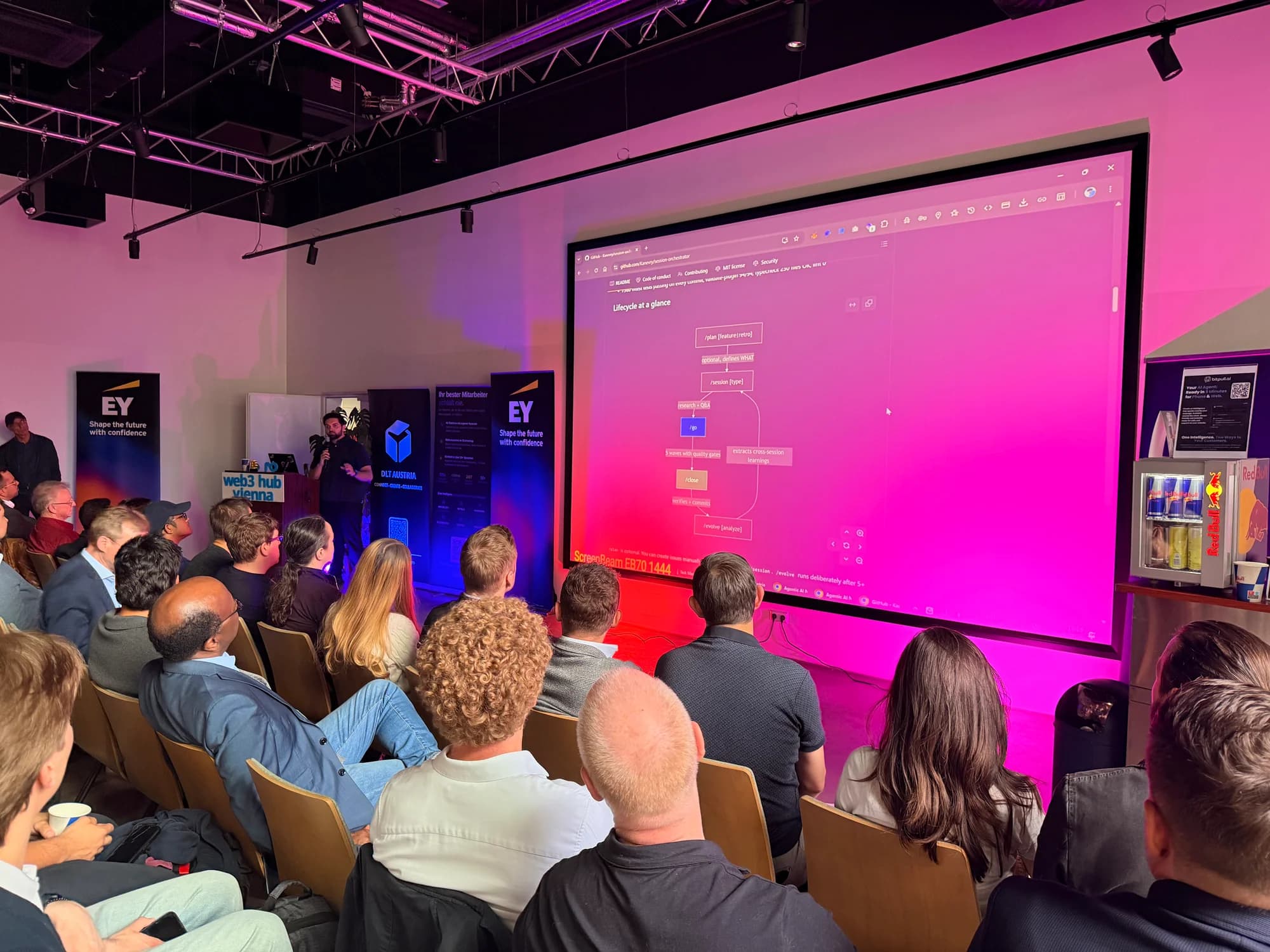
The second evening was the meetup at the web3 hub vienna on 10 June. Here the audience was technical, the room was full, and I had something concrete with me: session-orchestrator, one of my open-source tools, live on the big screen. I showed the whole lifecycle, from planning through the session and execution to closing and review. Installation in two slash commands, on the open README. And then my own GitHub profile with the daily open-source work as proof that this is not demo theatre but my everyday work.
That is the difference that matters to me. I could not talk about a tool someone else built. I showed what I use myself every single day. When a critical question came from the room, I did not have to dodge it, because I was not talking about a slide, I was talking about running code.
The third evening was the panel "Architecture & Development in the New" at the Vienna Software Architecture Meetup on 16 June, in the Accenture stock exchange building on Schottenring. The panel was held in English. On the stage sat Accenture twice over, plus SQUER and fab4minds. And me. The others spoke from the enterprise and consulting perspective. Next to Accenture, SQUER and fab4minds, I was the only solo voice on the panel.
How It Feels to Be on Your Own Next to the Big Names
Let me be honest: when you sit on a panel as a solo builder next to two people from Accenture and the Chief Technologist of SQUER, the first reflex is to think about your own standing. No big company name on the badge, no team behind you, no consulting structure.
But that turned out to be a strength on the panel itself. The others describe how software development is changing inside large structures. I live that change radically myself, with no approval process, no guideline committee, nobody who can forbid me a tool. My agents write, test and review, and I am the final quality judge. This way of working is hard for a guardrail-bound organisation to replicate one to one, and that is exactly the counterpoint a panel like this needs.
I do not get on a stage to be a speaker. I get up there because I build every day and have something to show.
On the panel I argued a clear, fairly polarising position: that verification, not typing, has become the scarce skill, and that a guardrail-bound organisation has a harder time making that shift than an individual does. I could back it up cleanly, because lived practice sits behind the opinion, not theory. There is a difference between "I believe it will go this way" and "this is how I have worked every day since late 2024". A room full of software architects hears that difference immediately.
A Talk Is a By-Product of the Substance
This is the common thread across all three evenings, and it is more than a slogan. I do not see myself as someone who gives talks. I see myself as someone who builds. The appearances are a by-product of there being substance worth talking about.
The difference is not cosmetic. It changes what happens on stage:
- I cannot get thrown off when someone pushes back. When the topic is your own daily work, there is no slide to hide behind. A critical question is then not a risk but an invitation to get concrete.
- I do not need borrowed authority. No "according to a study" as a crutch. At the BitGN PAC hackathon in April I entered solo and scored 79 of 104 points on site in three hours, with second place at 65. That is not a talking point, it is a verifiable result. I wrote up how that evening went separately: how I won the BitGN hackathon solo.
- The setting was an exchange, not a sale. With an audience of peers, of software architects and senior devs, it was about practice and patterns. A pitch would have been the wrong reflex there.
That is exactly why the order matters to me. The work first, then the stage. Not the other way around. Whoever does it the other way builds a speaker identity that eventually detaches from their own substance. I would rather be the one who sits back at the keyboard the next day and builds what he talked about yesterday.
What Stuck With Me on the Content Side
I am only touching on the actual theses here, because they belong in their own articles, not in a recap. But two lines came up again and again across the technical evenings, and they are worth naming briefly.
The first is the shift in the bottleneck. Producing code has become easy. The real work today is judging whether it holds up. The scarce skill is no longer typing, it is verification. Whoever signs off owns it, and responsibility cannot be delegated to a model.
The second is the adoption gap. Established teams genuinely struggle with this shift, and that is not an accusation. Guardrails and review processes exist for good reasons, and they make exactly this change slower. The problem is not the pace itself, but the growing gap between what the tools can do today and what a grown structure can actually absorb. Both topics deserve more depth than a stage recap can give them.
Conclusion
Three evenings, three rooms, one stance. What I take away for myself comes down to three points.
- The stage is a mirror of the work, not a substitute for it. On all three appearances I only told the story of what I actually do. That carried every evening, from the non-technical career panel to the English-language architecture panel.
- Being solo next to the big names is not a disadvantage but a counterpoint. Precisely because I have no consulting structure behind me, I live the change unfiltered. On a panel that is worth more than a well-known logo.
- The talk stays a by-product. I keep building, every day. When something comes out of it that is worth talking about, I talk about it. In that order.
I have collected the photos from the three appearances in the "Appearances & Proof" gallery on my about page, in case you want to see what these evenings looked like. Since 05/2026 I am also active as Venture Builder at AI Factory Austria, but the solo brand stays my home base.
If you want to start building with AI agents yourself instead of just talking about it: there is a free handout and a newsletter at agenticbuilders.at. No pitch, just a starting point for everyone who ticks the same way.