Three Stages in Two Weeks
Three Vienna appearances in two weeks: a career panel, a live session-orchestrator walkthrough, and a software architecture panel.
TL;DR
Within two weeks I joined three events in Vienna: the waff Future Fit Festival at the Vienna Museum of Science and Technology, a session-orchestrator walkthrough at web3 hub vienna, and the Vienna Software Architecture Meetup. Each room needed a different level of detail. The useful lesson was how much the same subject changes with the audience.
Three Rooms, Three Versions
The first event was the "Code your Career" panel at the waff Future Fit Festival on 3 June. The audience included career changers, returners, and people considering their first technical role. Architecture diagrams would not have helped. I spoke about the slower part of my own transition: learning in the evenings and on weekends, building prototypes, going to events, and eventually moving into AI work full time.
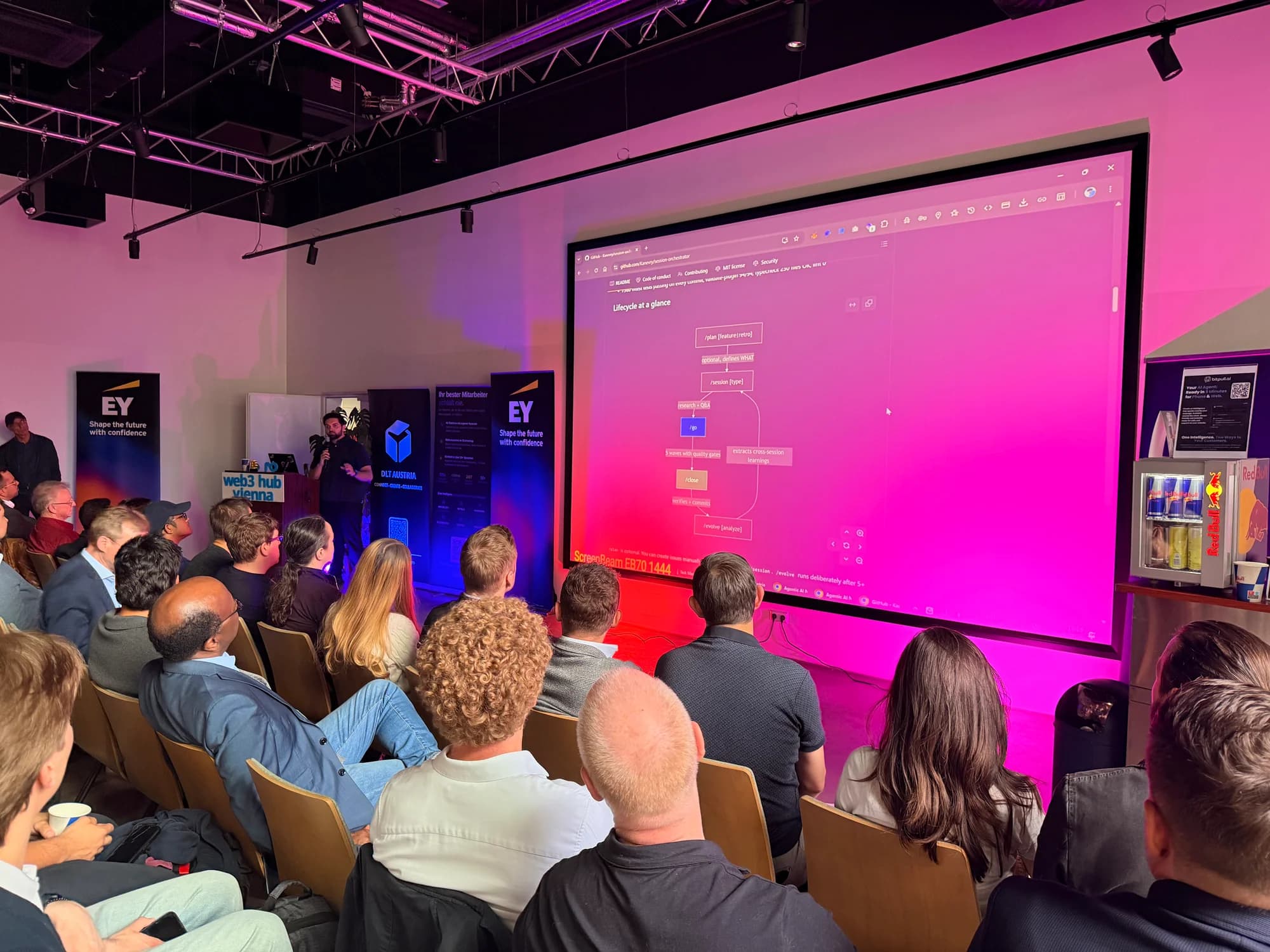
On 10 June, the room at web3 hub vienna was technical. I opened session-orchestrator and walked through the lifecycle from planning to execution, review, and close. We installed it from the public README in two slash commands. Questions went straight to the mechanics: how state survives an interruption, what happens after a failed gate, and where a human decision stops an automated run.
The third event was the panel "Architecture & Development in the New" at the Vienna Software Architecture Meetup on 16 June. The other panelists brought experience from Accenture, SQUER, and fab4minds. I described my solo workflow: agents write, test, and review; I set the direction and decide what ships. A solo setup can change quickly. A larger organisation has to fit the same tools into existing responsibilities, security rules, and approval paths.
Two Questions That Followed Me Home
The first was about verification. Producing a plausible implementation has become cheap. Checking whether it fits the repository, survives tests, and solves the intended problem still takes attention. I have worked with AI agents daily since late 2024, and that review step remains the bottleneck in my own work.
The second was about adoption. A tool can improve faster than an organisation can approve and absorb it. That delay is not automatically a failure. Existing controls often protect real responsibilities. The practical question is where a team can create a bounded space to test a tool without bypassing those controls.
The three events approached those questions from different angles. At the career panel, the relevant question was how to start learning. At the meetup, it was how the workflow behaves when something fails. On the architecture panel, it was how the workflow changes once several people and responsibilities are involved.
One Concrete Reference
At the BitGN Personal Agent Challenge in April, I built an agent solo for three hours on site. It finished rank 15 of 222 published entries worldwide and rank 1 at the Vienna hub. The hackathon recap covers the preparation, scoring, and five security layers.
That example came up because it makes the verification question concrete: the agent ran against a deterministic benchmark and had to defend against prompt injection, data leaks, and destructive tool calls. The result did not remove the need for review. It showed where the security layers held and where they needed work.
What I Changed Afterward
The events did not produce a new grand theory. They gave me better questions for the repository. Which parts of the workflow are easy to explain only when they are running? Which controls are useful in a solo project but too loose for a team? Where does a failed check stop the process, and who makes the next decision?
Those questions fed back into the tools and into later articles on verification and the approval gap in organisations.
Photos from the three appearances are in the appearances section. The free handout at agenticbuilders.at covers the basic workflow shown at the meetup.